Brief Background and History of Amish People
From church division in 17th-century Europe to growing communities across North America, the Amish story is rooted in conviction, tradition, and a unique way of life.
Origins in Europe
The Amish story begins within the Mennonite Church, where strong convictions about church discipline and tradition led to a lasting division.
Two Mennonite leaders, Hans Reist and Jacob Amman, began to struggle over certain religious practices in the church.
In a confrontation with Reist’s followers, Jacob Amman excommunicated Reist and his leaders, causing shock throughout the Mennonite communities of Western Europe and deep divisions within the church.
After years of banning and excommunicating nearly half of all Mennonites, calmer voices began to reason with Jacob Amman. In an attempt to show repentance, Amman excommunicated himself and some of his own leaders.
In 1699 and again in 1700, he tried to rejoin the Mennonites, but reconciliation was refused due to continuing differences in doctrine, interpretation of Scripture, and tradition.
Key Facts About Jacob Amman
- Jacob Amman excommunicated over half of the Mennonites.
- The Mennonites, in turn, excommunicated Jacob Amman.
- Amman later excommunicated himself from his own group as a sign of repentance.
- Jacob Amman, spiritual leader and founder of the Amish faith, died while still banned and excommunicated.
Coming to America
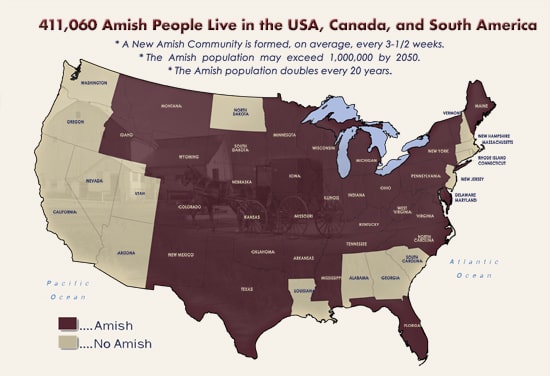
On October 2, 1727, the first Amish people arrived in America on a ship named The Adventurer and settled in Philadelphia, Pennsylvania. Over time, Amish communities spread throughout the United States, Canada, and South America.
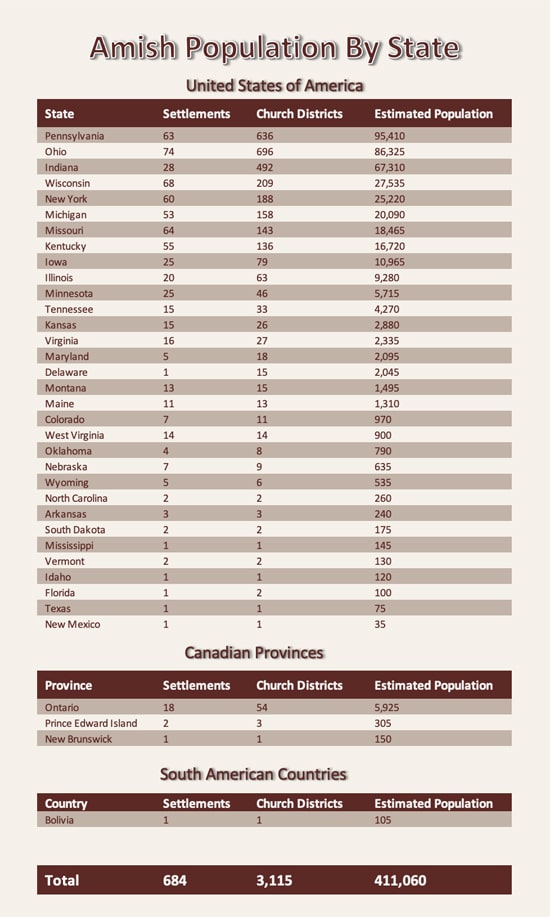
Today, there are more than 411,060 Amish people living in 684 settlements and 3,115 church districts (see charts below). Pennsylvania has the largest population, with Ohio close behind. Holmes County, Ohio, attracts hundreds of tourists daily, drawn by Amish hand-crafted woodwork, quilts, candies, flea markets, auctions, and hearty home-cooked meals.
Three Languages in Daily Life
The Amish speak Pennsylvania Dutch at home. This is their everyday, family language.
They learn to speak, read, and write English by the first or second grade. In some communities, they also learn German at school on Fridays, so they can read the Bible, prayer books, and song books, which are translated into German.
Faith, Rules, and the Ordinance Letter
There are several Amish “denominations,” including Old Order, New Order, Beachy, Tobe, Troyer, and Swartzentruber, among others. While some groups are more open-minded, most lean heavily on a detailed list of “do’s and don’ts.”
This list of rules, called the Ordinance Letter, can be over 20 pages long. It covers dress, employment, equipment, transportation, salaries, and entertainment. It is kept by the community’s bishop and strongly enforced to maintain unity.
Those who do not abide by the rules may be disciplined up to and including excommunication and shunning for a period of time, “turning them over to Satan” until there is repentance.
The Bible, translated into German, is difficult for many to fully understand and is not to be carried outside the home. Group Bible studies beyond immediate family are generally frowned upon or forbidden. Commonly quoted passages in church include Romans 12:1–2, James 2:20, and 1 John 2:15–17.
Work, Government, and Daily Life
Amish children learn the value of work at a very young age. By second grade, many are already milking cows and helping in the fields.
Adults stay as far away from politics as possible. They do not vote and take no part in war. However, they still pay taxes like any other American citizen.
Many Amish refuse to own a Social Security number, and some go as far as refusing birth certificates for their children.