

The question often arises about morality and whether atheists can be good moral people. The short answer is, yes, atheists can live moral lives. Some surpass the moral lives of religious people who have a very strict moral code they aspire to live by. In this essay, I want to examine the value of following a moral standard and how it differs for an atheist and a Christian.
Oftentimes, we like when others are moral people, but if we are honest with ourselves, we don’t always enjoy being moral people ourselves. It seems to hinder personal freedom and pleasure.
There are over four million roads in the United States, and more than 250 million cars on these roads. The numbers are staggering. If you sit and watch the cars at any major intersection, it seems like a miracle that more people don’t get into accidents every day.
But, somehow, so many cars driving so close to each other are able to avoid contact and arrive safely at their destination. What protects them from each other? It is a system of laws put in place to ensure that many cars can be on the roads at the same time while maximizing safety. As long as drivers observe the laws of the road, they are relatively safe. The laws are not there to take away from the driving experience, or to hinder people from getting to their destination, but instead they help get people to their desired destination.
Morality works on a similar principle to this concept. It is not in place to restrict freedom, nor to take the fun out of life, but instead it helps people have the best of life. Let’s consider the aspect of freedom. Many people feel as if morality keeps them from having true freedom, but usually when they say freedom, they are talking about the ability to do what they want, how they want, and when they want to. This is not freedom. This is anarchy.
Anarchy is destructive to self and others, and in the big picture of things, takes away freedom and pleasure.
Let’s go back to the analogy of the road system. As long as a person stays within the prescribed rules of the road, they can travel with freedom across the country and enjoy many things along the way. But the instant they decide to forgo the laws, they are putting themselves and others at risk. The same principle applies in morality. As long as a person stays within the bounds of morality, they have much more freedom for themselves personally and are in less danger of harming those around them.
It becomes very evident that morality is good, even for a person who does not subscribe to any religion. What is not as clear is the motivation for morality. For the Christian, the goal is to become more like Christ, who is the model of morality, and the ultimate desire of Christians is to be as much like Christ as they can.
For the atheist, it is more ambiguous. It might be because of an instinctiveness within that tells them this is beneficial for them, or perhaps it is a more thought-out philosophy that makes them realize morality is better than anarchy.
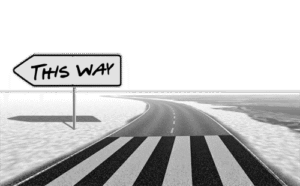
Using the analogy of the road system, the atheist is one who remains faithful to the laws and ways of the roads, but drives aimlessly about, not heeding the signs that point to a specific location. The Christian also stays within the laws and ways of the road, but they have a definite location in mind, which is to arrive at the place of being Christ-like. So, rather than just remaining within the structure but not having a destination, Christians observe the signs that tell them which direction to go in order to arrive at their destination.